
Table of Contents
Essential Employee Benefits for Small Businesses
Offering competitive employee benefits is vital for small businesses aiming to attract top talent and remain competitive. We understand that budget constraints can feel limiting, but creating meaningful benefit packages is more about strategic choices than sheer spending. According to the U.S. Chamber of Commerce, even smaller organizations can build custom perks that significantly improve employee happiness, health, and retention.
Effective small business employee benefits are achievable. The key is focusing on value, customizing offerings, and conducting thoughtful planning. Navigating the complexity of benefit regulations alongside core business operations can be challenging, which is why our team acts as a seamless extension of yours.
This is where professional employee benefits administration services can make a difference, managing the details and keeping you compliant. Let’s explore the specific benefits that matter most and how to manage them effectively.
Preparing to Choose Employee Benefits
Before diving into specific plan options, it helps to gather a few key pieces of information. Preparing to select employee benefits for your team can feel overwhelming, but with the right groundwork the process becomes much more manageable. We believe that thoughtful preparation turns a complex task into a clear, step-by-step journey.
Start by compiling a snapshot of your current workforce. Document the age range, family situations, common health concerns, and geographic locations of your team, especially if you have remote or hybrid employees. This demographic view directly shapes which small business employee benefits will offer the most value.
Next, review your total compensation budget and decide on a target spending percentage for benefits. Then create a simple two-column exercise:
- Must-have benefits: items like health insurance or retirement plans.
- Nice-to-have benefits: items like pet insurance or wellness perks.
Gather key company documents such as payroll reports, headcount data, and existing benefit plan contracts. Collect any compliance records related to employee benefits compliance, including ACA and COBRA notices. Finally, write down the questions you want a benefits provider to answer, such as the level of support they offer for enrollment and ongoing employee inquiries.
This preparation sets you up for a productive conversation about your benefits strategy. For answers to common questions about the preparation process and the support available, visit our HR services FAQ page. Once you have your information organized, you will be ready to compare the benefit options that fit your business best.
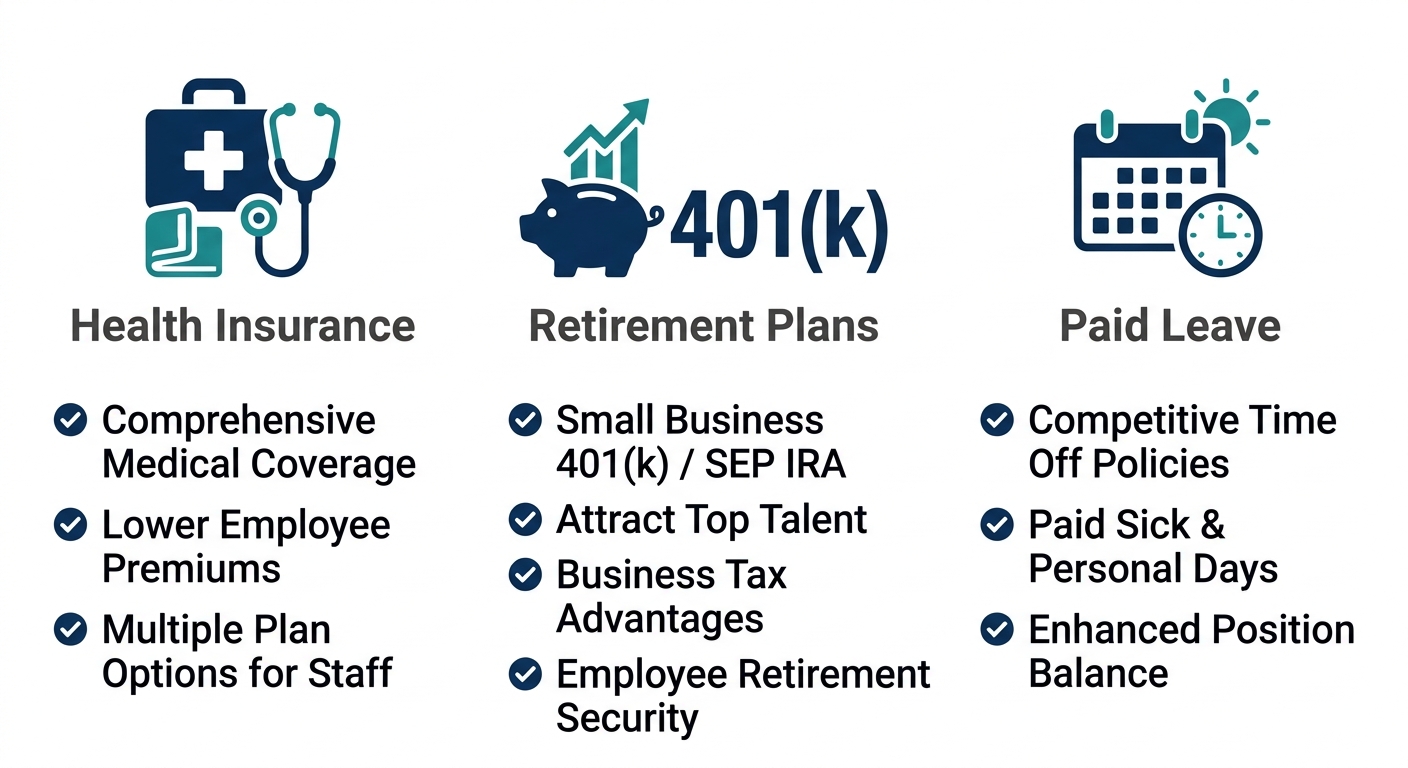
Essential employee benefits options for small businesses
Structured path for small businesses evaluating and selecting employee benefits.
Understanding employee benefits is the first step to building a stable and motivated team. For small businesses, this means separating legal requirements from elective offerings that attract and retain talent. We help you navigate both.
Mandatory benefits are non-negotiable. Per the Internal Revenue Service (IRS), you must provide Social Security and Medicare (FICA), federal unemployment tax (FUTA), state unemployment insurance, and workers’ compensation insurance. Failing to do so can result in penalties.
Beyond the essentials, you can implement a robust small business employee benefits package. Common discretionary benefits include health insurance, dental and vision plans, retirement plans like a 401(k), paid time off, and life insurance. The right mix varies by your business size and industry.
Ensuring correct employee benefits compliance is critical as you weigh these options. Our team administers these tasks as part of our comprehensive support. We handle all aspects of workers compensation administration, from claims processing to payroll tracking, helping you meet your obligations. Please consult a qualified professional for legal or tax advice.
Calculate the Cost of Employee Benefits
Once you’ve decided which benefits to offer, the next step is to calculate their total cost. Understanding your employee benefits spending is critical for budgeting and for attracting top talent in a competitive market. The U.S. Chamber of Commerce reports average benchmarks that can guide this process.
For typical small business employee benefits, you’ll need to estimate costs for the four main categories: health insurance, retirement, paid leave, and voluntary benefits. A clear formula is (Monthly premium per employee × 12) + employer 401(k) match + the value of paid time off. Benefits often represent 30-35% of total compensation. As you calculate, factor in employee benefits compliance responsibilities like ACA and COBRA administration, which impact your administrative overhead. However, these requirements vary; we recommend consulting a qualified professional for advice specific to your situation.
Reviewing your employee wellness and health policies can help you identify cost savings and improve employee health outcomes. Partnering with a PEO allows you to access enterprise-level rates and administration, making this process far easier. We become an extension of your team, handling the heavy lifting so you can focus on growth. With a clear picture of costs, you can move forward with enrolling employees and staying compliant.
Choose Health Insurance That Supports Talent Attraction
Once you’ve assessed plan options, the next strategic step is choosing health insurance that directly strengthens your ability to attract top performers. In today’s competitive market, a thoughtful employee benefits package is a powerful lever for talent attraction–far beyond a simple compliance checkbox.
Small businesses often face a disadvantage when trying to build competitive benefits offerings alone. Securing cost-effective access to medical, dental, vision, and 401(k) plans requires buying power most small employers don’t have. According to the Internal Revenue Service (IRS), offering small business employee benefits can also be a tax-advantaged strategy, as employer-sponsored health coverage is generally excluded from wages and can serve as a recognized tool for retention.
That’s where we change the equation. Through our PEO model, we pool our clients’ collective strength to unlock Fortune-500-level benefits that make your offer package compelling to candidates. A dedicated partner like the My HR Pros management team ensures your benefits are both competitive and compliant, removing the administrative burden while upholding strict employee benefits compliance. We become an extension of your team, managing everything from open enrollment to COBRA notifications.
This talent-attraction advantage is just one way we help your business grow. Next, let’s look at how we simplify ongoing administration.
Navigate Employee Benefits Compliance Requirements
Once you’ve selected the right employee benefits for your team, navigating the compliance requirements becomes your next priority. The IRS requires specific reporting, such as Form W-2 for health coverage and Form 5500 for retirement plans. For small business employee benefits compliance, you must also understand how the Affordable Care Act employer mandate applies if you qualify as an applicable large employer.
Beyond coverage, ERISA governs most private-sector health and retirement plans, requiring you to provide plan descriptions and summary plan descriptions. If you have 20 or more employees, COBRA administration is another critical compliance obligation. You must also monitor state-specific benefit mandates, like paid sick leave, as non-compliance can result in IRS penalties or DOL fines. Aligning with these regulatory requirements for employee benefits protects your company and your people. We help you manage these layered obligations with confidence. To simplify your responsibilities, access our HR resources and client portal for checklists and plan management tools.
Outsource Benefits Administration with a PEO
Managing employee benefits in-house is time-consuming work that distracts from core operations. From open enrollment coordination to carrier communications, the paperwork alone can overwhelm a small team. Small business owners often discover that once they have selected a benefits package, running the day-to-day administration remains a heavy burden.
A PEO handles the full lifecycle of small business employee benefits — medical, dental, vision, supplemental plans, and 401(k) administration. We become an extension of your team by managing open enrollment, processing claims issues, and administering COBRA notifications so nothing falls through the cracks.
Compliance adds another layer of pressure. Employee benefits compliance involves staying current with ACA reporting requirements, state-level mandates, and COBRA deadlines — areas where oversight can lead to costly penalties. Our team provides hands-on support with these regulatory obligations so you can focus on growth instead of paperwork.
According to the U.S. Chamber of Commerce, benefits contribute significantly to employee happiness and retention, but the administrative weight is real. With a PEO handling benefits administration, you reclaim your time while giving employees access to stronger benefit options through pooled buying power.
Design a Competitive Benefits Package
Beyond base pay, a competitive employee benefits package is often the deciding factor for top talent. According to the U.S. Chamber of Commerce, companies that fail to offer strong benefits risk losing their best people to larger organizations. A well-rounded benefits offering includes health, dental, and vision insurance, plus retirement plans like a 401(k) and supplemental options. Through our PEO model, we pool employees across client companies to give your team enterprise-level plans at rates typically reserved for Fortune 500 corporations.
Offering small business employee benefits also introduces serious compliance responsibilities such as ACA, COBRA, and ERISA. These obligations create a hidden burden for any employer. We become an extension of your HR team to manage employee benefits compliance and administration, reducing your legal risk and freeing you to focus on your business. Once the package is designed, the next critical step is maintaining it properly — something we handle as an integral part of your PEO partnership.
Adjust Your Benefits Strategy Over Time
Once your initial benefits package is in place, it is essential to revisit it regularly so your employee benefits program stays aligned with both your people and your plans. A static approach can quietly undermine a growing business. Conducting an annual review tied to your open enrollment or fiscal cycle creates a natural checkpoint for assessing your benefits offerings and making informed adjustments.
Growth milestones often trigger the need to adapt your benefits strategy. Adding five or more team members can shift your administrative burden, and crossing the 50 full-time-equivalent threshold brings new responsibilities under the Affordable Care Act. Beyond headcount, staying current with IRS and Department of Labor guidance is a cornerstone of employee benefits compliance. Surveying your team’s satisfaction at least once a year also reveals hidden gaps–perhaps staff now value dental, vision, or 401(k) options that would boost retention and competitiveness in your market.
When your small business employee benefits need fine-tuning, leaning on a PEO can transform a complex review into a smooth progression. We become an extension of your team, managing the adjustment process while you focus on the work that moves your business forward.
Overcoming Common Employee Benefits Challenges
For small and mid-sized businesses, designing and managing employee benefits ranks among the most demanding operational responsibilities. Business owners wear too many hats already, and staying current with plan options while running daily operations often stretches internal resources past their breaking point.
Administrative Burden and Compliance Pressures
Benefits administration extends far beyond selecting a health plan. Employers must handle ongoing enrollment, carrier communications, and detailed recordkeeping. According to the Internal Revenue Service, fringe benefits, health plan contributions, and educational assistance programs each carry distinct tax treatment rules that require careful tracking. The employee benefits compliance landscape adds further complexity as reporting and notice requirements under ERISA, the ACA, and COBRA continue shifting at both state and federal levels. A single missed deadline or filing error can trigger penalties that small businesses can ill afford.
The U.S. Chamber of Commerce reinforces that employers should research legal mandates including workers’ compensation and unemployment insurance before rolling out any voluntary offerings. These obligations multiply quickly for organizations without dedicated in-house HR expertise.
Cost Pressures on Small Business Employee Benefits
Small business employee benefits packages nearly always cost more per employee than the rates large organizations negotiate. The Chamber’s guide notes that individual group medical coverage averages roughly $500 monthly, while family plans can reach $1,500. Dental premiums add $20 to $50 per person, and retirement plan administration carries annual fees on top of any employer matching. Without economies of scale and carrier leverage, leaner teams absorb disproportionately higher per-head expenses for comparable employee benefits.
These administrative, compliance, and cost pressures do not simply resolve themselves. Overcoming these hurdles begins with a strategic partnership.
Building a Solid Employee Benefits Foundation
A strong employee benefits package is the cornerstone of attracting and retaining the skilled people your growing company needs. As the U.S. Chamber of Commerce confirms, a thoughtful benefits strategy directly impacts workplace satisfaction and long-term retention. Navigating employee benefits compliance and administration, however, pulls small business owners away from their core operations.
That’s where we step in. By partnering with My HR Professionals, you gain a single team that manages your small business employee benefits administration, handles complex compliance requirements, and controls costs efficiently. We become an extension of your team, so you can focus on leading your business while we safeguard your benefits strategy.
Ready to build your foundation? Let’s talk about how we can support your goals.
Disclaimer: This information is provided for general informational purposes and should not be taken as legal, tax, or financial advice. A formal service agreement is required to establish a client relationship.
This article was researched and written with the assistance of AI tools.