
Table of Contents
Navigating Multi-State Payroll Compliance for Growing Businesses
One of the biggest hurdles businesses face as they expand beyond their home state is maintaining effective multi state payroll compliance. This critical function means adhering to differing state tax, wage, and reporting laws for a dispersed, often remote workforce. As companies hire employees across state lines or open new locations, payroll complexity increases exponentially. Each state enforces unique rules for income tax withholding, unemployment insurance, and workmens comp coverage, turning a routine process into a regulatory maze.
The stakes for getting it wrong are significant. The IRS and individual state agencies can levy steep penalties for misreporting or non-compliance, and the risk of triggering a costly audit grows with every new jurisdiction entered. Tracking evolving legislation and filing requirements across multiple states quickly exceeds the capacity of most growing businesses without dedicated HR and payroll support. With each state maintaining its own wage and hour standards, staying current demands constant vigilance and proactive oversight. This is where understanding multi-state tax nexus becomes essential, as establishing a sufficient business presence in a new state fundamentally changes your obligations for multi-state payroll processing.
For legal or tax advice, consult a qualified professional. In the following section, we’ll break down key state-by-state compliance rules every employer needs to know.
Fundamentals of Multi-State Payroll Compliance
Understanding multi state payroll compliance is a foundational step for any employer who has team members located in more than one state. Multi-state payroll compliance refers to the complex process of adhering to the wage, withholding, and reporting laws across two or more states simultaneously. According to the U.S. Department of Labor, each state can impose its own distinct payroll regulations, and failing to meet these multi-jurisdiction payroll rules can lead to significant penalties, making a clear strategy for compliance across state lines essential from the very first out-of-state hire.
What Is Multi-State Payroll Compliance?
Multi-state payroll compliance is the practice of ensuring all payroll-related activities–from calculating wages and deducting taxes to filing reports–are executed according to the specific laws of every state where your employees work. This goes beyond simply issuing a paycheck; it requires an in-depth understanding of diverse minimum wage rates, overtime rules, and pay frequency laws. When an employee’s location triggers a multi-state tax nexus, an employer establishes a tax presence that mandates registration with that state’s agencies. Without this careful coordination, businesses risk underpaying taxes or missing critical reporting deadlines, which can result in costly audits and interest charges.
Why Small Businesses Face Unique Compliance Risks
Small businesses face a disproportionately high level of risk with multi state payroll compliance because they rarely have a dedicated payroll or human resources department to track the shifting regulatory landscape. In a smaller organization, these duties often fall to an owner or a general manager who is already juggling countless other operational tasks. This lack of specialized support makes it easy to miss a critical update, such as a new local ordinance or a change in a state’s unemployment insurance rate. As highlighted by SHRM’s best-practices framework, these oversights can trigger severe financial penalties that are especially difficult for growing companies to absorb, turning an administrative error into a serious threat to the bottom line.
Common Mistakes in Multi-State Payroll Compliance
Several recurring mistakes can derail even the most well-intentioned small business owner who is managing multi-state payroll processing. These errors are often simple in nature but carry significant consequences, from steep fines to employee dissatisfaction. Recognizing these frequent pitfalls is the first step toward building a more resilient and compliant payroll process.
- Misclassifying remote workers: Treating an out-of-state remote employee as if they still work at the company headquarters, which fails to apply the tax and wage laws of the employee’s actual jurisdiction.
- Ignoring local wage-and-hour laws: Overlooking city or county-level mandates concerning meal breaks, predictive scheduling, or higher local minimum wages.
- Applying a single tax rate: Using one static withholding table for all employees, which ignores the distinct state-specific rates and the unique State Unemployment Tax Act (SUTA) requirements for each location.
Information is for informational purposes only; consult a qualified professional for advice specific to your situation.
Common Multi-State Payroll Mistakes vs. Best Practices
The following table pairs each common oversight with a proven best practice and illustrates how professional support can offer a solution. Understanding these pitfalls is the first step toward a compliant multi-state payroll strategy.
| Common Mistake | Best Practice | How a PEO Can Help |
|---|---|---|
| Not registering for payroll taxes in a new state before hiring a remote employee | Register with state tax agencies as soon as a nexus is established | PEO handles state registrations and ensures timely filings |
| Using a single payroll tax rate for all states | Apply state-specific withholding rates and SUTA tax tables | PEO maintains up-to-date tax tables and automates rate application |
| Ignoring local wage-and-hour laws (e.g., meal breaks, overtime thresholds) | Create a compliance checklist for each state where employees work | PEO provides ongoing compliance monitoring and updates as laws change |
Understanding Multi-State Tax Nexus for Payroll
Before diving into compliance tasks, it is essential to understand what triggers an obligation in the first place: tax nexus. Mastering multi state payroll compliance begins with a clear understanding of when a business presence creates a duty to register and remit taxes in a new jurisdiction. For small employers, this concept can quickly become complicated, but breaking it down into its core components makes it manageable.
What Is Multi-State Tax Nexus?
Tax nexus is the minimum degree of business presence that requires an employer to register, withhold, and remit state payroll taxes. This presence can be physical or economic. According to the U.S. Department of Labor, establishing what creates a multi-state tax nexus is the first step in meeting interstate payroll obligations. As interstate commerce grows, more businesses discover they have created a connection with a state they may never have visited. This connection legally obligates the employer to comply with that state’s payroll tax codes, even if the company’s headquarters is located elsewhere.
How Payroll Creates Tax Nexus in Multiple States
Payroll activities alone can establish nexus across multiple states, often without the employer realizing it. Common triggers include:
- Leasing an office or owning property in a different state.
- Hiring a remote employee who works from a home office in a new state.
- Sending a worker temporarily for a project, conference, or training.
- Storing inventory or equipment in a state where you have no staff.
Each of these connections can obligate an employer to begin multi-state payroll processing, turning what was a simple local payroll into a complex cross-state tax responsibility. Even a single remote hire working from a coffee shop across state lines can create a new nexus that requires immediate attention.
Payroll Tax Nexus Thresholds for Small Businesses
Small businesses must be particularly vigilant about numeric and economic thresholds. Many states set specific day limits before nexus is triggered–often around 30 days of work performed within their borders. Economic presence rules frequently kick in when an employer surpasses $100,000 in sales or 200 transactions in a year. The table below summarizes the most common triggers and actions required.
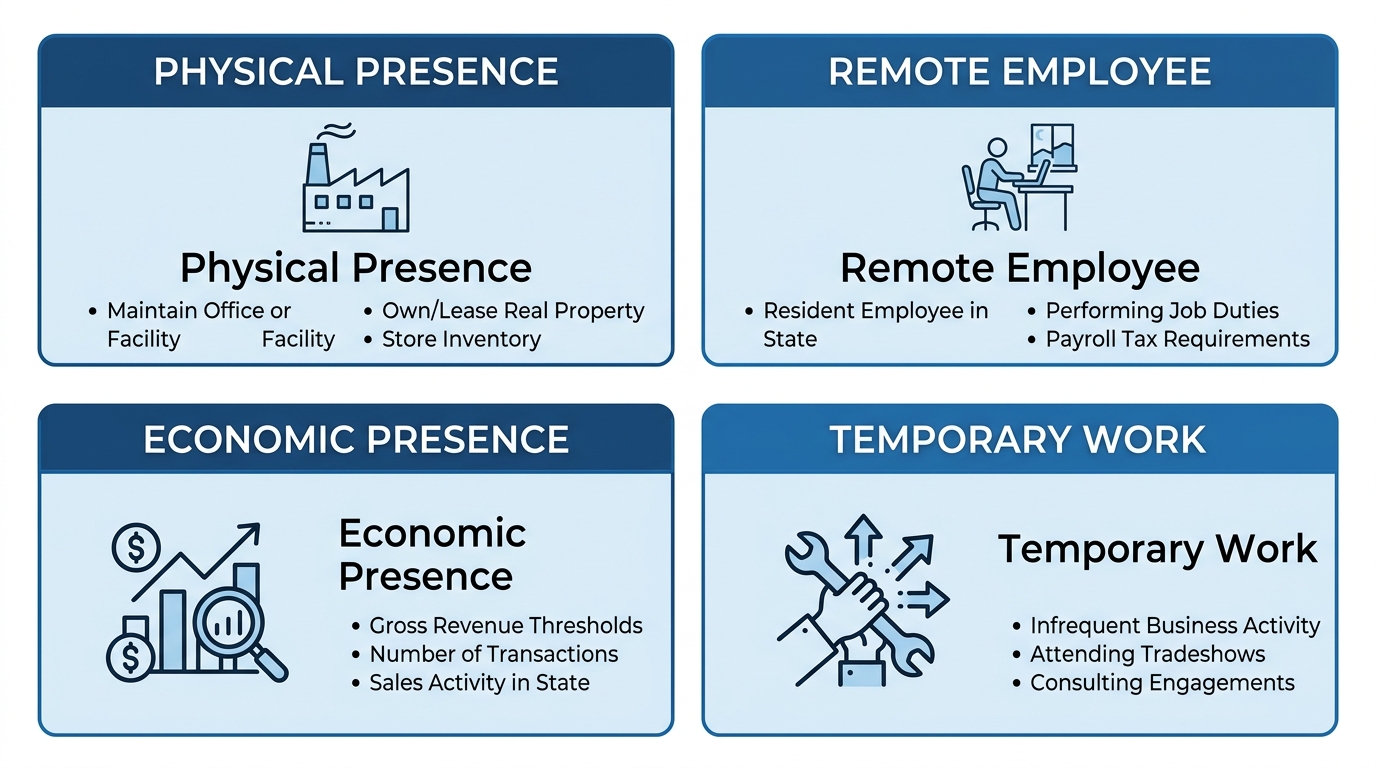
Four key state tax nexus triggers for small employers explained.
| Common Mistake | Best Practice | How a PEO Can Help |
|---|---|---|
| Not registering for payroll taxes in a new state before hiring a remote employee | Register with state tax agencies as soon as a nexus is established | PEO handles state registrations and ensures timely filings |
| Using a single payroll tax rate for all states | Apply state-specific withholding rates and SUTA tax tables | PEO maintains up-to-date tax tables and automates rate application |
| Ignoring local wage-and-hour laws (e.g., meal breaks, overtime thresholds) | Create a compliance checklist for each state where employees work | PEO provides ongoing compliance monitoring and updates as laws change |
Source: Adapted from U.S. Department of Labor, SBA, and SHRM guidance. Thresholds vary by state; consult a qualified professional for your specific situation.
These thresholds represent the critical tipping point where awareness of multi state payroll compliance shifts from theoretical to urgently practical. Monitoring these triggers accurately helps employers avoid penalties and register timely.
Managing Nexus for Remote Employees
The rise of remote and hybrid work has made tracking employee locations one of the most challenging aspects of maintaining compliance. Employers must know where work is physically performed each day to determine when a new state nexus is triggered. The convenience of the employer rule in some states assesses nexus based on where the employer is located, while the physical presence rule in others focuses on where the employee sits. In the U.S. Department of Labor guidance, the emphasis is on accurate recordkeeping to uphold multi state payroll compliance. For ongoing assistance, many employers turn to professional human resource support to manage these tracking obligations.
Once you have identified where you have nexus, explore my hr pros services for help with registration and ongoing compliance.
Information on this website is for informational purposes only and should not be considered legal, tax, or financial advice; consult qualified professionals for advice specific to your situation.
Practical Guide to Multi-State Payroll Processing
Building on the basics of payroll, let’s examine the practical realities of processing payroll when your team spans multiple states. Navigating multi state payroll compliance is a critical priority for any growing business, and we understand the complexity it introduces. This guide breaks down the core concepts, challenges, and actionable solutions for managing multi-state payroll processing effectively.
What Is Multi-State Payroll Processing?
Multi-state payroll processing is the end-to-end cycle of managing employee pay across different state jurisdictions. It goes far beyond simply issuing checks. It involves the precise calculation of wages, withholding the correct amounts for state income tax, State Unemployment Tax Act (SUTA) contributions, and various local taxes, then filing the appropriate returns on time. According to the U.S. Department of Labor, compliance with state-specific payroll requirements is a fundamental employer responsibility. Understanding when a multi-state tax nexus is established–triggering these obligations in a new state–is the first step in building a compliant interstate payroll strategy. This process demands rigorous attention to detail to reconcile data and ensure every employee’s earnings and deductions are accurate, no matter where they live and work.
Challenges in Multi-State Payroll Processing and Solutions
Managing multi-jurisdiction payroll presents unique operational hurdles. Here are the most common challenges and practical solutions to address them:
- Juggling Different Tax Calendars: Each state sets its own deposit frequencies and filing deadlines, often on a weekly, monthly, or quarterly basis. Missing a single date can trigger penalties. Solution: Implement a centralized payroll calendar with automated reminders for every state-level deadline you are obligated to meet.
- Managing Varied Paid Leave Laws: Paid sick leave, family leave, and short-term disability laws differ significantly from one jurisdiction to another. An employee in Colorado accrues leave differently than one in Michigan. Solution: Deploy a leave management policy tracker that integrates with your payroll system to automatically apply the correct accrual rates based on an employee’s primary work location.
- Reconciling Multi-State Payroll Data: With employees spread across multiple locations, consolidating payroll data for general ledger reporting and internal audits can become a tangled mess. Solution: Use payroll software with robust multi-state reconciliation reports that automatically segregate wages, taxes, and deductions by state.
- Managing State-Specific Tax Registrations: Before you can withhold taxes, you must register for an employer account with each state’s revenue and unemployment agencies, a process that can take weeks. Solution: Create a standardized state tax registration checklist and consider working with a partner that can handle these registrations on your behalf, ensuring you don’t exceed nexus thresholds before being properly set up.
Best Practices for Multi-State Payroll Processing Compliance
Building a foundation for multi state payroll compliance requires a systematic approach. Based on recommendations from the Society for Human Resource Management (SHRM), we advocate a proactive checklist for our clients. First, centralize payroll data into one system of record to eliminate silos. Second, standardize the state tax registration process to ensure you are registered in every state before an employee performs any work there. Third, audit payroll periodically–conducting quarterly reviews of source data and tax filings can help catch errors well before year-end. Finally, leverage technology for automation, such as cloud-based software with automatic tax table updates, and assign a dedicated internal coordinator or partner with a Professional Employer Organization (PEO) to oversee the entire scope of compliance across multiple states.
Tools for Automating Multi-State Payroll Processing
Evaluating tools for automation involves checking for specific features that streamline multi-jurisdiction payroll. Key capabilities include automated updates to state tax tables, multi-state tax filing for income and unemployment taxes, time tracking integration that maps hours to correct jurisdictions, and compliance monitoring alerts. The Small Business Administration highlights the importance of robust systems for managing a remote workforce’s payroll logistics across state lines.
The following table compares these critical features across standalone software and a PEO arrangement.
| Nexus Trigger | Description | Common Thresholds for Small Employers | Action Required |
|---|---|---|---|
| Physical Presence | Leasing office space, owning property, or having inventory in the state | Any physical presence typically creates nexus | Register with state tax authority immediately |
| Remote Employee Location | An employee works remotely from a state where the employer has no physical office | Varies by state; some have a day-limit (e.g., 30 days) before nexus is triggered | Track days worked; register if threshold met |
| Economic Presence (Sales) | Making sales into the state above a certain dollar or transaction threshold | Often $100,000 sales OR 200 transactions per year (state-specific) | Monitor sales volume; register once thresholds are crossed |
| Temporary Work / Travel | Employees temporarily working in a state (e.g., for a project or conference) | Convenience-of-Employer rule vs. Physical Presence rule (state-dependent) | Apply state-specific withholding rules for temporary work periods |
While standalone software can manage certain aspects, it often requires add-on modules and per-state filing fees that increase costs and complexity. A PEO, on the other hand, bundles these tools into a single service. We become an extension of your team, providing expert oversight and a dedicated client advocate. This partnership allows you to access these features along with expert oversight and dedicated support as part of comprehensive payroll services. This approach can help reduce administrative burden and support your multi-state payroll compliance efforts more holistically than software alone.
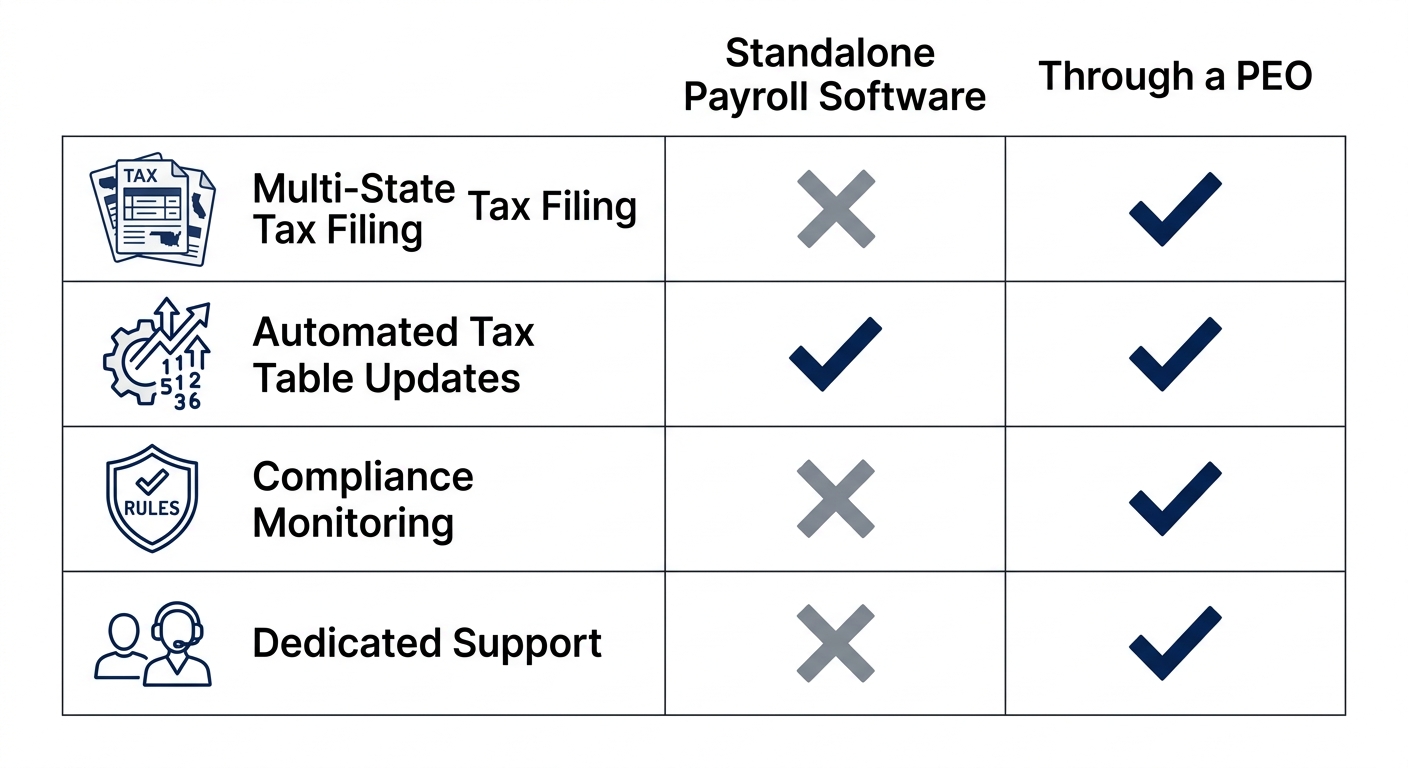
Multi-state payroll processing tools and features comparison
With these foundational practices and tools in place, the next step is understanding how specific state regulations impact payroll decisions. Ready to grow your business?
Information on this website is for informational purposes only and does not constitute legal, tax, or financial advice. Consult qualified professionals for advice specific to your situation.
Advanced Strategies for Multi-State Payroll Compliance
While single-state payroll compliance has its own challenges, expanding into multiple states introduces a new layer of complexity that requires a proactive, systematic approach. At My HR Professionals, we understand the weight of managing obligations in multi-state payroll compliance, and we guide businesses through the essential steps to stay ahead of evolving requirements.
Determining Nexus and Registration Triggers
The first critical step is understanding what creates tax nexus and registration obligations in a new state. According to industry best practices from the Society for Human Resource Management, a business can establish physical nexus by having an office, a remote employee working from home, or even a single sales representative in a state. Many states now also enforce economic nexus rules, triggered when a company exceeds specific revenue thresholds or transaction counts, as highlighted in guidance from the U.S. Small Business Administration. Once a multi-state tax nexus is identified, you must register with the state’s department of revenue for income tax withholding and its unemployment insurance agency. Timely registration is crucial, as it directly impacts when withholding must begin, helping you avoid penalties and interest on unfiled returns.
Administering Withholding and Streamlining Processing
Effective multi-state payroll processing begins once registrations are in place. Managing multi-state withholding requires clear processes for collecting and verifying state-specific W-4 forms from employees. It’s also essential to analyze reciprocity agreements between states, where applicable, as these can exempt employees residing in one state from withholding in another, provided proper paperwork is on file. At My HR Professionals, we help clients navigate these nuances by integrating withholding instructions directly into our processing platform, which automates calculations and reduces manual error, supporting more consistent compliance across multiple states.
Remote Workers, Classification, and Coverage
Remote workforce dynamics add another layer of complexity. Beyond tax withholding, you must verify how worker classification–such as employee versus independent contractor–influences your tax obligations in each jurisdiction. Workforce classification across state lines also requires careful review of workmens comp requirements, as coverage rules and benefit levels vary by jurisdiction. State workers’ compensation laws often impose different requirements for remote employees, and failure to carry adequate coverage can lead to significant fines. Our team works alongside your business to verify coverage extends appropriately for all locations, fully aware that we are an HR support service and not a source of legal advice.
By implementing these strategies, businesses can build a scalable compliance foundation. Next, we explore how technology can streamline multi-state payroll processing and create efficiencies as your operations grow.
To help clarify the most common questions employers have about their obligations, we have answered a few key ones below. Many employers find multi state payroll compliance challenging when they have employees working across state lines.
What creates a multi-state payroll compliance obligation for my business?
A single employee performing work in a different state–even remotely from home–can establish a multi-state tax nexus, according to the U.S. Department of Labor. This typically requires your business to register for payroll taxes in that state and begins a layer of multi-state payroll processing that includes managing different wage bases, tax rates, and filing calendars for each location.
How do I register for payroll taxes in a new state where I have one remote employee?
The standard registration sequence generally means filing with the new state’s Department of Revenue for income tax withholding and then registering with the state workforce agency for state unemployment insurance, a process the U.S. Small Business Administration identifies as a core duty for any business with a distributed workforce. In most cases, having even one remote worker in the state triggers full registration obligations.
Which state’s tax rules apply to a remote employee?
Tax withholding normally follows the state where the work is performed, but be aware that convenience-of-the-employer rules apply in states such as New York, Nebraska, and Delaware. These rules can shift the tax obligation back to the employer’s home state, adding another layer of complexity that requires constant attention.
Navigating these rules requires constant attention. We become an extension of your team to handle the complexity. Ready to grow your business?
Simplify Your Multi-State Payroll Journey
Managing multi state payroll compliance is rarely straightforward. As your team grows across state lines, you encounter a tangled web of registration requirements and employer obligations that differ from one jurisdiction to the next, turning routine paydays into a recurring puzzle.
At My HR Professionals, we become an extension of your team so you don’t have to interpret multi-state tax nexus rules or juggle multi-state payroll processing alone. We shoulder the administrative heavy lifting on your behalf, helping you stay organized without taking your focus away from running the business. Let’s explore how to manage this step by step.
This article was researched and written with the assistance of AI tools.