
Table of Contents
PEO Services: The Key to Streamlined HR Operations
Managing HR in-house can quickly overwhelm small business owners with administrative tasks. That is where PEO services come in. A PEO, or professional employer organization, handles essential HR functions, giving you time to focus on what you do best.
Under a co-employment arrangement, we become the employer of record for tax and compliance purposes while you retain full control over daily operations, according to the U.S. Chamber of Commerce. We manage payroll processing, benefits administration, workers’ compensation, compliance, and employee onboarding so you can run your business without the administrative burden and reduce the daily distractions of HR management.
For a peo for small businesses, this partnership often provides access to high-quality benefit plans typically reserved for larger corporations. A peo for restaurants can help reduce the complexities of high-turnover workforces, offering stability and HR expertise that may help level the playing field.
We become an extension of your team, providing the dedicated support you need to handle human resources efficiently and grow your business with confidence.
Outsourcing HR functions allows leaders to redirect their energy toward strategic growth, customer service, and operational excellence. This partnership model helps create a more focused and productive organization.
What Is a PEO and How Does the Co-Employment Model Work?
At its core, a Professional Employer Organization (PEO) is a company that enters into a co-employment relationship with your business to manage payroll, benefits, HR compliance, and risk management. This arrangement, often called co-employment, allows us to become an extension of your team–One Team, One Company–so you can focus on daily operations and strategic growth. According to the U.S. Chamber of Commerce, the PEO model enables small and mid-sized businesses to access enterprise-level benefits and compliance resources that would otherwise be out of reach.
Defining the Professional Employer Organization (PEO)
A PEO acts as an administrative partner, handling essential workforce management functions while you retain full authority over hiring, firing, supervision, and every other day-to-day decision. Through this co-employment partnership, we process payroll, administer employee benefits, manage workers’ compensation claims, and support HR compliance with federal and state regulations. For example, a restaurant owner or professional services firm can offload I-9 verification, E-Verify processing, and FMLA leave tracking to our team, freeing up hours previously spent on administrative tasks.
Small businesses benefit from economies of scale because PEOs pool employees across multiple clients to negotiate better rates on health insurance, dental, vision, and retirement plans. When you choose a PEO for small businesses, you gain the purchasing power of a large corporation without sacrificing the personal attention your team deserves. Similarly, a PEO for restaurants provides targeted support for high-turnover environments, helping managers stay compliant with OSHA safety recordkeeping while maintaining consistent onboarding and offboarding procedures. The result is a streamlined HR infrastructure that supports your culture rather than replacing it.
How Co-Employment Works in Practice
Under the co-employment model, the PEO becomes the employer of record for tax and insurance purposes, while your business retains complete control over employees’ day-to-day work and management decisions. Practically, this means My HR Professionals files payroll taxes, maintains workers’ compensation coverage, and issues W-2s under our tax ID, but you continue to schedule shifts, approve time-off requests, and evaluate performance. The U.S. Chamber of Commerce emphasizes that co-employment does not alter your authority over operations–it simply shares specific employment liabilities and administrative responsibilities.
For daily workflows, employees notice very little change. They still report to your managers, follow your procedures, and represent your brand. Behind the scenes, we process payroll, handle benefits enrollment, and maintain compliance documentation so you can concentrate on delivering exceptional products or services. This shared responsibility model allows you to focus on growing your business while we handle the complexities of HR.
How PEO Services Support HR Compliance
Navigating the patchwork of federal, state, and local employment regulations can overwhelm even the most diligent business owner. Our PEO services help you stay compliant by managing OSHA safety recordkeeping, tracking FMLA leave, processing E-Verify cases, and assisting with agency responses when questions arise. According to the U.S. Chamber of Commerce, PEOs act as guides through regulatory requirements, though they do not provide legal advice. The client remains responsible for employment decisions, and we reinforce that our role is to support–not replace–your own compliance obligations.
For example, when a restaurant faces a DOL audit or a healthcare practice needs updated safety documentation, our expertise helps you prepare records and respond accurately. We monitor changing regulations and update your employee handbook templates, I-9 processes, and workers’ compensation protocols accordingly. For more focused assistance on specific HR tasks, our human resource support services can step in to handle everything from discipline and termination consulting to customized reporting.
While we provide the tools and guidance to reduce risk, no PEO can guarantee a specific compliance outcome. Every business is unique, and your circumstances may require consultation with qualified legal or financial advisors. Information on this website is for informational purposes only and should not be considered legal, tax, or financial advice. We encourage you to speak with a professional who understands the full scope of your situation before making any significant employment or compliance decision.
The Benefits of Partnering with a PEO for Your Business
Partnering with a PEO gives small and mid-sized businesses a distinct competitive advantage by offloading time-consuming human resources tasks. We become an extension of your team, handling payroll, tax filings, and compliance so you can focus on what you do best–growing your business. According to the U.S. Chamber of Commerce, PEO clients are 50% less likely to close and experience 12% less employee turnover, outcomes rooted in the stability and support a professional employer organization provides.
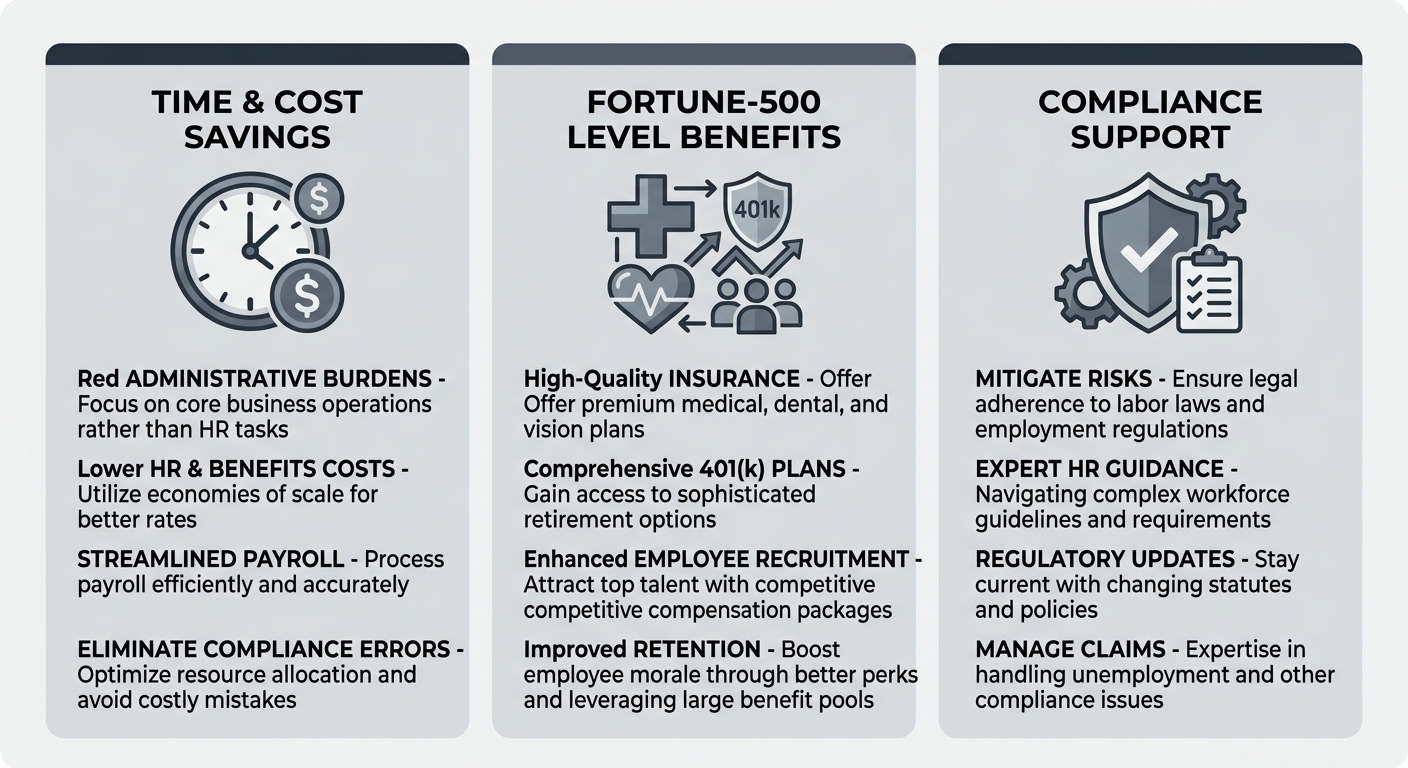
A visual breakdown of the key advantages a PEO offers a small business.
Key Benefits for Small and Growing Businesses
A PEO for small businesses transforms HR from a daily headache into a strategic advantage. The typical business owner can reclaim significant hours each week by transferring payroll processing, onboarding paperwork, and regulatory filings to a dedicated payroll processor. This time savings alone often justifies the partnership, but the value extends much further.
Through our employee benefits administration services, we manage enrollments, open enrollment, and COBRA notifications, helping you attract and retain talent. Small businesses gain access to Fortune 500-quality medical, dental, vision, and 401(k) plans they could never negotiate on their own. By pooling employees across multiple client companies, a PEO leverages collective buying power to secure rates typically reserved for large corporations.
Industry-Specific Advantages for Restaurants and Hospitality
A PEO for restaurants addresses the unique operational pressures of the food service industry. Tip processing, which carries complex IRS reporting requirements, becomes seamless when managed by experienced payroll specialists. Seasonal staffing fluctuations–ramping up for summer patios or holiday catering–no longer strain internal resources because the PEO handles rapid onboarding, E-Verify processing, and offboarding.
Compliance demands in hospitality are relentless, spanning wage-and-hour laws, safety inspections, and workers’ compensation claims. Our team tracks changing regulations and manages OSHA recordkeeping, reducing the risk of costly violations. With one dedicated point of contact, restaurant owners spend less time on paperwork and more time delighting guests.
The Financial and Operational Impact of PEO Services
Beyond day-to-day relief, PEO services fundamentally level the playing field. Small businesses gain HR infrastructure that rivals Fortune 500 companies–dedicated client advocates, professional payroll processors, and software for time and attendance, applicant tracking, and customized reporting–at a value-focused price point. Features like pay-as-you-owe workers’ compensation align costs with actual payroll, improving cash flow predictability.
The operational impact compounds quickly. Owners redirect energy previously consumed by administrative fires toward revenue-generating activities, employee development, and customer experience. This shift from reactive management to proactive strategy is where true growth begins, and it sets the stage for understanding how a PEO partnership works in practice.
Information on this website is for informational purposes only and should not be considered legal, tax, or financial advice. Consult qualified professionals for advice specific to your situation.
How PEO Services Handle Payroll, Benefits, and Compliance
To understand how a PEO truly delivers value, we need to examine the core functions that directly impact your day-to-day operations. A professional employer organization becomes the employer of record for tax and compliance purposes, handling the heavy administrative lifting while you maintain control over your team’s daily activities. For small businesses and those in industries like hospitality, a peo for restaurants takes on specialized tasks such as tip reporting and tip credit calculations, while a peo for small businesses in other sectors tackles the universal challenges of payroll complexity and benefits management.
Payroll Processing and Tax Administration
A PEO streamlines payroll by managing every detail from gross wages to net pay, ensuring accuracy and timely delivery. Our team handles the complete cycle, including calculating hours, processing direct deposits, and managing all tax withholdings at the federal, state, and local levels. According to the U.S. Chamber of Commerce, this includes the preparation and filing of W-2s and the administration of state unemployment taxes, which can become particularly complex for businesses with employees in multiple states.
Beyond basic calculations, a professional employer organization brings structure to multi-state compliance. We track nexus thresholds, register for state accounts, and remit taxes to the appropriate jurisdictions, reducing the risk of penalties from missed deadlines or incorrect filings. We become an extension of your team, providing the expertise needed to navigate these obligations while you focus on running your business.
Benefits Administration Through a PEO
We understand that managing benefits can be overwhelming for a growing business. A PEO takes on the responsibility of administering your entire benefits package, from medical, dental, and vision plans to supplemental insurance and 401(k) retirement accounts. This includes guiding your employees through the initial enrollment process and managing annual open enrollment periods, ensuring that everyone understands their options and meets critical deadlines.
A key advantage of our PEO services is the ongoing compliance support for mandates like COBRA and Medicare Part D notifications. As noted by the U.S. Chamber of Commerce, failing to provide timely COBRA notices can lead to significant penalties. Our team ensures these legal requirements are met, allowing you to offer competitive, large-company benefits that help attract and retain top talent without the administrative burden.
Cost Structures: Understanding PEO Pricing Models
PEO pricing is typically built around a transparent, per-employee-per-month (PEPM) model, making it a predictable expense as your team grows. This flat fee generally covers the core administrative services, with costs varying based on the scope of services, your company’s size, and industry risk profile. For early-stage companies just beginning to scale, a dedicated peo solution for startups can offer predictable pricing and scalable benefits that adjust as your workforce expands.
Other cost factors can include a one-time setup fee to establish your account and systems, as well as administrative surcharges on certain benefits. Our value-focused approach emphasizes maximizing your investment through bundled service offerings. For instance, our PEO packages include discounted bookkeeping services and a “pay as you owe” workers’ compensation model that improves cash flow by aligning premium payments with actual payroll cycles rather than requiring large, annual upfront deposits.
Information provided is for informational purposes and should not replace professional legal, tax, or financial advice.
Now that you see how a PEO operationally handles the critical areas of payroll, benefits, and pricing, the next step is understanding how to choose the right partner. The following section will guide you through evaluating providers, from verifying their certifications to assessing their cultural fit with your organization.
Best Practices for Selecting a PEO Partner
Once you understand the benefits of a PEO, the next step is finding the right partner for your business. Choosing a PEO is a significant decision that will impact your daily operations, company culture, and long-term growth. We believe the selection process should be thorough and thoughtful, focusing on finding a partner who truly becomes an extension of your team.
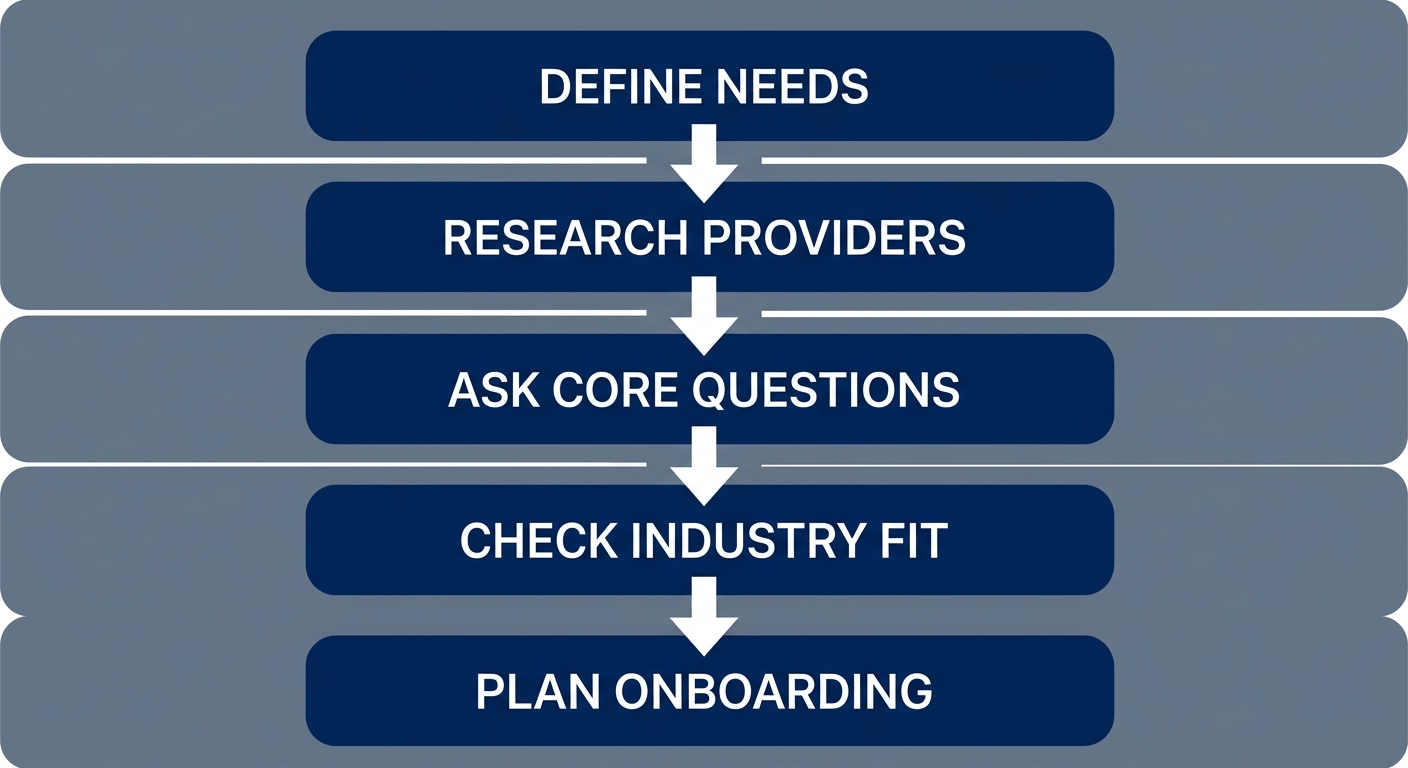
Five-step vertical process for choosing a PEO service provider
Questions to Ask When Evaluating PEO Providers
When you sit down with a potential PEO partner, come prepared with a detailed list of questions. The answers you receive will reveal a great deal about their capabilities and service philosophy. According to the U.S. Chamber of Commerce, a leading business resource, due diligence is essential when evaluating professional employer organizations.
Key questions to guide your evaluation include:
- What accreditations do you hold, such as ESAC certification or IRS Certified PEO (CPEO) status, and when was your last independent audit?
- Can you describe the structure of your dedicated customer support? Will we have a single point of contact or a team?
- How does your technology platform manage onboarding, payroll reporting, and employee self-service? Can we see a demo?
- What is the complete fee structure, and are there any hidden costs or service limitations we should know about upfront?
- Can you clearly explain your contract terms, including the renewal cycle and any required notice period for exiting the agreement?
These questions will help you quickly identify a PEO that prioritizes transparency and accountability.
Matching PEO Services to Your Industry Needs
Every industry has its own regulatory landscape and operational hurdles, so your PEO partner should have demonstrable experience in your specific field. An ideal PEO for restaurants, for instance, will understand the complexities of tip reporting, high employee turnover, and fluctuating schedules. For healthcare practices, a PEO must be well-versed in HIPAA compliance, professional licensing verification, and patient data security.
When searching for a PEO for small businesses, it’s crucial to ask potential providers for client references or case studies from companies of a similar size and in a related industry. A partner with the right expertise brings proactive solutions rather than reactive fixes. We encourage you to look for a PEO provider who not only understands your challenges but has successfully navigated them for other clients, ensuring they can act as a true strategic partner from day one.
Integrating PEO Solutions with Your Existing HR Operations
The transition to a new PEO partner should be a structured, phased process, not a rushed handoff. A smooth integration validates your choice and sets the stage for a productive partnership, and a good PEO will handle complex aspects like multi state payroll compliance from the outset. We recommend the following steps to ensure a seamless onboarding experience:
- Start with a dedicated kick-off call: Establish a clear communication plan between your internal team and the PEO’s client advocate to align on timelines and responsibilities. Data mapping is the critical first technical step.
- Audit and prepare your data: Carefully gather and review all employee census data, payroll history, tax payment schedules, and current benefit plan documents. Clean data is the foundation of accurate payroll from day one.
- Migrate in phases: Instead of a single, high-risk data dump, migrate employee information and payroll data in logical batches. This makes it easier to spot and correct discrepancies before they become systemic problems.
- Validate and train in parallel: While the PEO verifies the migrated data against payroll registers and quarterly tax reports, conduct comprehensive training for your staff on the new technology platform and timekeeping systems.
By treating onboarding as a collaborative project, we ensure that when you go live, your operations are accurate, compliant, and ready to support your business goals.
Empowering Your Business with a PEO Partnership
A PEO partnership empowers small business owners to focus on what they do best–running their restaurant or growing their small business–while we handle the complexities of HR and compliance. As an extension of your team, we become a strategic ally dedicated to your long-term success.
This model is where a PEO for small businesses truly shines. By shifting employer-related liabilities, including comprehensive workers compensation administration, claims processing, and payroll tracking, the co-employment model significantly reduces your risk burden. We provide guidance on federal, state, and local employment laws, from FMLA and OSHA to E-Verify, helping you navigate these regulations without the fear of costly violations.
For restaurant owners especially, a PEO for restaurants offers a distinct advantage. By pooling employees, we give you access to Fortune 500-level benefits like medical, dental, vision, and 401(k) plans, which are essential for attracting and retaining top talent in a competitive labor market. According to the U.S. Chamber of Commerce, this access allows smaller companies to manage HR costs and compliance without hiring internal specialists.
Ready to grow your business? This partnership means you can focus on your passion while we become an extension of your team, working together as One Team, One Company.
This article was researched and written with the assistance of AI tools.