
Table of Contents
PEO vs ASO Comparison: What Small Businesses Need to Know
Building on outsourcing options, here’s a direct peo vs ASO comparison to help small businesses decide. A Professional Employer Organization (PEO) uses co-employment, acting as the employer of record for payroll taxes and benefits, per Indiana Department of Workforce Development guidance. An Administrative Services Organization (ASO) handles admin tasks without sharing liability, as the client remains sole employer.
Key PEO and ASO Differences:
- Structure: PEOs certify joint liability; ASOs keep client as sole employer.
- Services: PEOs provide full HR, risk management; ASOs focus on payroll, compliance.
PEO vs ASO Benefits: PEOs grant access to group benefits and expertise, aiding retention, according to Illinois CPA Society insights. ASOs offer flexibility with less commitment.
PEO vs ASO Costs: PEOs typically cost 3-15% of payroll; ASOs charge lower fees for admin only.
Consider workforce size, growth, and compliance–like Indiana UI rules–alongside your business needs before choosing.
Overview of PEO and ASO Models
Small businesses often struggle with HR complexities like payroll, benefits, and compliance. A PEO vs ASO Comparison reveals two key outsourcing models that address these needs. At My HR Professionals, we become an extension of your team by offering tailored solutions to streamline operations and reduce risks.
PEO Model
A Professional Employer Organization (PEO) operates under a co-employment model. The PEO assumes responsibility for payroll, benefits, compliance, and some HR functions, sharing employer status with the client. This provides a plug and play peo solution for seamless integration. According to authoritative state regulatory guidance from the Indiana Department of Workforce Development, PEOs must notify DWD and meet criteria like a client’s 12-month employment history and minimum size of two employees for unemployment insurance qualifications.
ASO Model
An Administrative Services Organization (ASO) handles administrative tasks such as payroll and benefits administration without co-employment. The client remains the sole employer of record, retaining full control over employees.
Key Differences
- Co-employment: PEO yes; ASO no.
- Risk sharing: PEO shares liabilities like unemployment taxes; ASO does not.
- Customization: ASO offers higher flexibility.
- Benefits access: PEO provides larger-group rates; ASO varies by client.
- Costs: PEO typically 5-15% of payroll; ASO 2-8% as pay-for-service.
PEO vs ASO benefits favor PEO for comprehensive risk mitigation and better benefits, while ASO suits firms seeking control. PEO vs ASO costs reflect PEO’s higher fees for shared responsibilities. Choose PEO for full HR relief in small businesses; ASO for larger ones wanting flexibility. Beyond the basics, let’s explore PEO vs ASO benefits and PEO vs ASO costs in detail.
Comparing Features of PEO and ASO
Building on these definitions, this PEO vs ASO Comparison reveals essential differences. PEOs from My HR Professionals deliver comprehensive co-employment and full-service administration for payroll, benefits, compliance, and HR needs. In contrast, ASOs provide limited advisory support without shared employer status. The table below contrasts these models across key areas, informed by authoritative sources like the Illinois CPA Society.
PEO vs ASO Feature Comparison
| Feature | PEO (My HR Professionals) | ASO |
|---|---|---|
| Co-Employment | Yes, shared legal employer status | No, client remains sole employer |
| Benefits Administration | Full enrollment, group rates, COBRA | Consulting and guidance only |
| Payroll & Compliance | Full processing, tax filing, OSHA | Administrative support |
| HR Support | Dedicated processors, training, onboarding | Policy development, advisory |
As detailed in the Illinois CPA Society’s authoritative CPA professional guide on PEO operations, this PEO vs ASO Comparison underscores PEO advantages. Our PEO model assumes co-employment liability, securing group benefits rates and handling PEO vs ASO benefits like full COBRA compliance–unmatched by ASO consulting alone. We manage complete payroll processing and OSHA recordkeeping, reducing client burdens. For HR, dedicated processors provide human resource support, including training and onboarding, far beyond ASO policy advice. These full-service elements enable small businesses to focus on growth.
This visual breakdown answers common queries on feature gaps, such as fuller benefits administration via PEOs and robust compliance handling. Businesses evaluating options often find PEOs’ integrated approach enhances efficiency and talent retention in competitive markets. Such comprehensive support aligns with our commitment as an extension of your team at My HR Professionals.
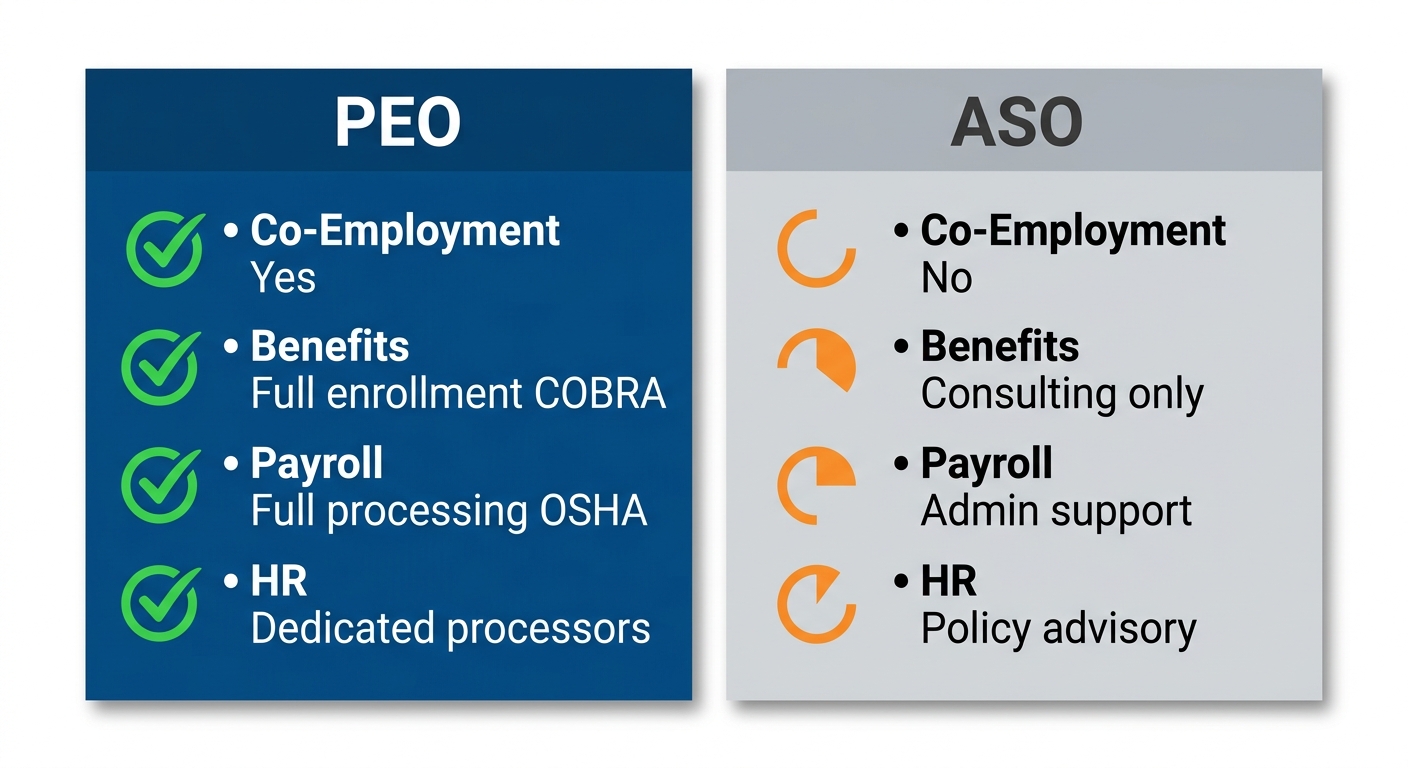
PEO vs ASO features comparison infographic
These feature differences also drive PEO vs ASO costs, with PEOs offering scalable value explored next.
PEO vs ASO Costs and Pricing Analysis
Beyond benefits, costs define the choice in PEO vs ASO Comparison. Professional employer organizations (PEOs) typically charge a payroll-based fee plus administrative costs, as outlined in authoritative CPA professional guidance from the Illinois CPA Society. This contrasts with administrative service organizations (ASOs), which often use a fixed monthly retainer. PEOs deliver group benefits rates for cost savings, per official state government employer guide from the Indiana Department of Workforce Development, while ASOs rely on individual plans that can run higher, with potential add-ons.
PEO vs ASO Pricing Comparison
| Cost Aspect | PEO | ASO |
|---|---|---|
| Structure | Payroll-based fee + admin | Fixed monthly retainer |
| Benefits Access | Group rates (cost savings) | Individual plans (higher) |
| Hidden Fees | Transparent, pay-as-you-owe | Potential add-ons |
This PEO vs ASO costs breakdown reveals short-term differences, but PEOs offer superior long-term value through risk mitigation and scalability. Transparent pay-as-you-owe structures reduce surprises, unlike ASO add-ons, enabling businesses to focus on growth. PEO vs ASO benefits shine in group rates, cutting expenses over time according to Illinois CPA Society insights on pricing transparency.
At My HR Professionals, we emphasize value-focused pricing as an extension of your team. Our bundled payroll services include discounted bookkeeping, enhancing ROI without hidden fees. These PEO-ASO pricing differences support sustainable expansion, as Indiana DWD notes on co-employment qualifications.
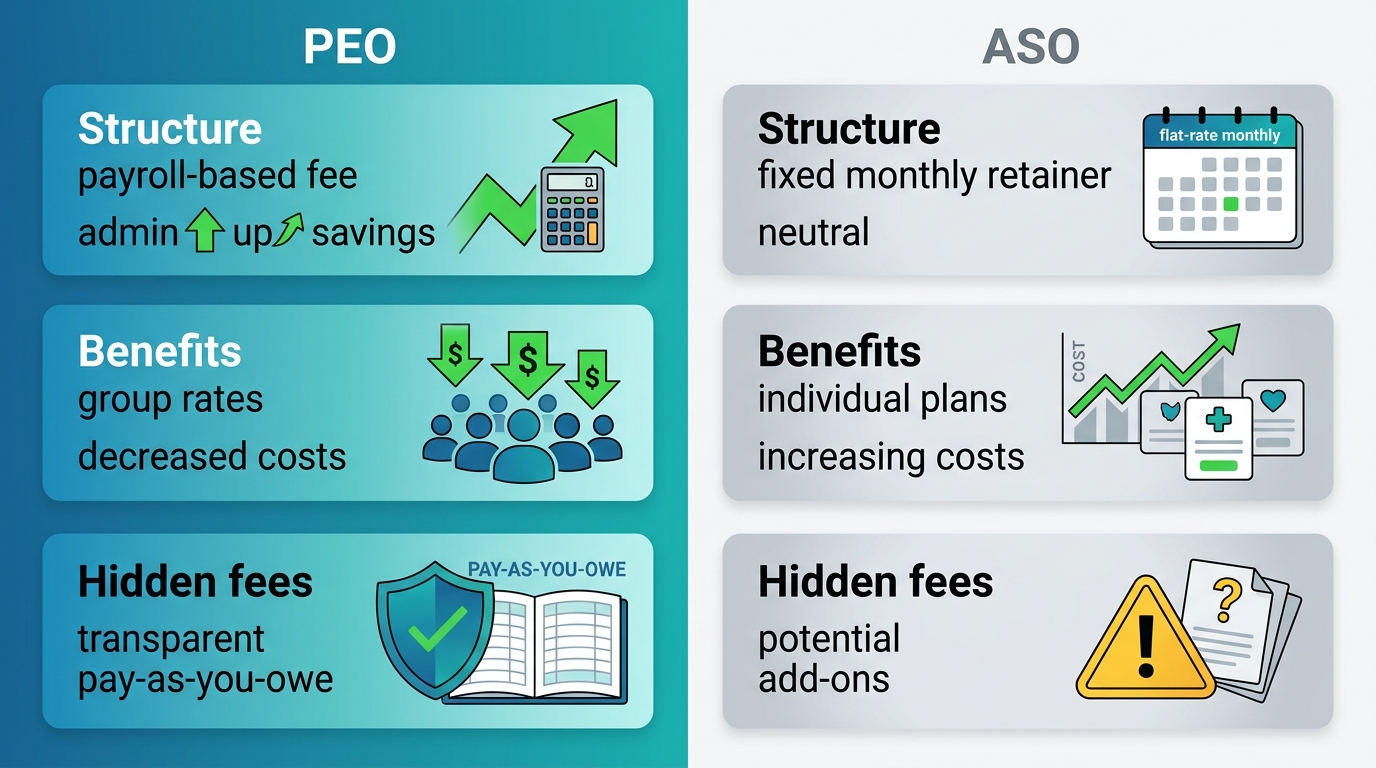
PEO vs ASO costs comparison highlighting transparent pricing and savings
These savings enable scalable growth for your business.
PEO or ASO: Which is Best for Your Business?
Now that you understand PEOs and ASOs, let’s dive into a PEO vs ASO Comparison to determine the best fit for your business. Wondering if a PEO or ASO is right for your business? We at My HR Professionals help small and growing companies navigate this choice daily.
A Professional Employer Organization (PEO) operates under a co-employment model, becoming the employer of record. We handle HR, payroll, benefits, and assume compliance risks like unemployment insurance. In contrast, an Administrative Services Organization (ASO) provides administrative outsourcing without co-employment, so you retain full employer status.
Key PEO vs ASO benefits include:
- PEO: Full-service HR relief, liability sharing, and access to better benefits rates.
- ASO: Retain control over employees with lower commitment levels.
- PEO excels for comprehensive support; ASO suits targeted admin needs.
PEO vs ASO costs typically range as follows:
- PEO: 3-10% of payroll, covering insurance and full services.
- ASO: 1-5% for administration only, offering cost savings for larger firms.
In Indiana, according to the Indiana Department of Workforce Development’s official state guidelines on PEO unemployment insurance qualifications and responsibilities, PEOs act as client-agents, receiving combined rate notices and paying contributions if clients fail.
We recommend PEOs for small businesses seeking full HR relief and ASOs for larger firms wanting control. Consider your size, growth stage, and risk tolerance. Check our hr payroll blog for payroll insights. Ready to choose? Explore implementation tips next.
Next Steps in Your PEO vs ASO Decision
Building on your PEO vs ASO Comparison, recall PEOs offer co-employment and risk sharing, unlike ASOs. To move forward, evaluate these differences for your business.
- Calculate total PEO vs ASO costs using your payroll data, including employee benefits administration.
- Audit HR compliance gaps to identify risks.
- Request customized quotes from 3+ providers.
- Schedule CPA consultations, as Illinois CPA Society (ICPAS) guidance recommends for financial analysis and operational impacts.
- Develop a 90-day trial plan.
We urge you to request quotes today. Contact My HR Professionals for expert PEO guidance and grow confidently.
This article was researched and written with the assistance of AI tools.