
Table of Contents
Mastering Multi-State Payroll Compliance
While single-state payroll is straightforward, multi-state adds layers. Here is how to master Multi state Payroll Compliance. Industry reports note 40% of U.S. businesses face these issues. Compliance means adhering to each state’s withholding, unemployment, and reporting rules.
Multi-state tax nexus triggers obligations through physical presence like employees or offices, or economic nexus from sales over $100K in many states. Identify it early to avoid penalties across state lines.
Streamline multi-state payroll processing with this 5-step workflow:
- Identify nexus states.
- Register for tax IDs in each.
- Track employee work locations via timekeeping.
- Calculate state-specific withholdings using localized rates.
- File quarterly returns per state deadlines.
Avoid pitfalls: misclassifying remote workers’ states, overlooking reciprocity like IL-MO, and missing annual rate changes. Use integrated payroll software or consult HR pros like My HR Professionals for audits. With these foundations, explore software solutions next for automation.
Prerequisites for Multi-State Payroll Success
Expanding operations across state lines introduces complex challenges in Multi state Payroll Compliance, where mismatched prerequisites can lead to costly fines from the IRS or state agencies. At My HR Professionals, we emphasize foundational steps to ensure seamless multi-state operations and avoid these pitfalls.
Establishing multi-state tax nexus is the first critical step. Businesses trigger withholding, unemployment, and income tax obligations when they meet thresholds like physical presence through employees or economic activity exceeding $100,000 in sales in a state. For instance, hiring a single remote worker in California creates nexus there, requiring immediate registration.
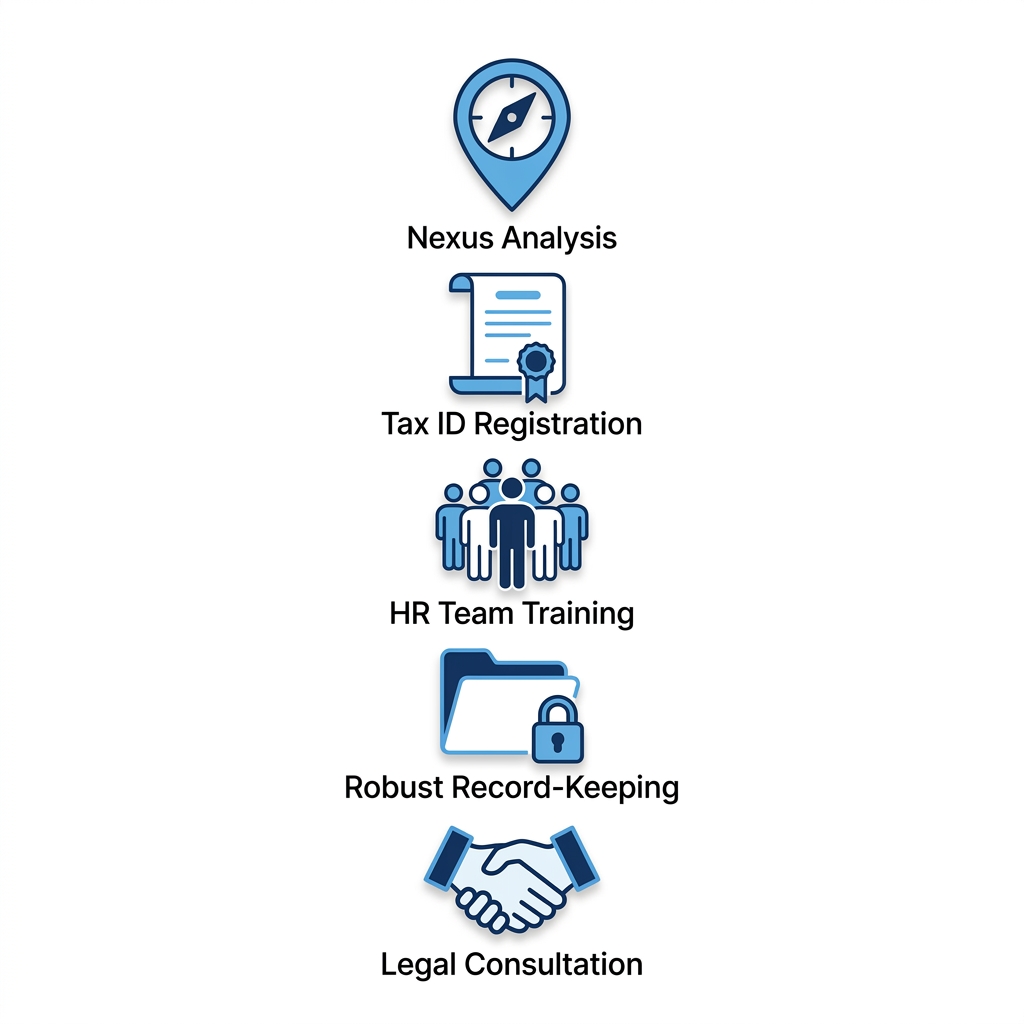
Icons of key prerequisites for multi-state payroll success
Selecting compliant software is essential for multi-state payroll processing. We recommend systems with real-time tax table updates, automated filings, and multi-jurisdiction reporting to handle varying wage rules and deadlines efficiently.
Key actionable prerequisites include:
- Conduct thorough nexus analysis per state.
- Register for all necessary tax IDs in applicable states.
- Train HR and payroll teams on diverse state laws.
- Implement robust record-keeping for audits.
- Consult tax experts for initial setup.
With these prerequisites in place, businesses can proceed to detailed processing strategies, minimizing risks and supporting growth. We become an extension of your team to guide you through Multi state Payroll Compliance.
Assess Your Business’s Multi-State Presence
As your business grows beyond one state, Multi state Payroll Compliance demands careful evaluation. Multi-state presence means any employee physically working, remotely reporting, or sales exceeding $100,000 or 200 transactions annually in another state per economic nexus rules.
Key Assessment Questions
- Do employees reside or work in states other than your headquarters?
- Have sales hit nexus thresholds in other states?
- Are contractors or vendors based interstate?
- Does your business ship products or services across state lines?
These questions link to multi-state tax nexus: physical presence via employees triggers withholding taxes, while economic nexus requires sales or use tax collection.
Map employee addresses using payroll records, review sales data against state standards like South Dakota v. Wayfair, and document findings in a compliance matrix.
State audits risk penalties up to 25% of unpaid taxes plus interest; update multi-state payroll processing immediately for compliance with payroll across multiple states. Once assessed, implement these strategies. We at My HR Professionals help with customized setups.
Calculate and Confirm Tax Nexus
Once multi-state operations are identified, calculate nexus as follows to achieve Multi state Payroll Compliance. We help businesses navigate multi-state tax nexus triggers like physical presence–one or more employees working in Texas, office space, or inventory storage–and economic thresholds post-Wayfair, such as $100,000 in sales or 200 transactions per state for sales tax (varying for payroll and income taxes).
Follow these steps for nexus thresholds across states:
- Tally total employee days worked per state annually. For example, if five employees work 100 days in Texas, that counts toward physical nexus.
- Sum sales volume and transaction counts by state.
- Compare against state-specific thresholds from Department of Revenue sites, noting multi-state payroll rules like de minimis exemptions for <10% payroll.
Confirm nexus using state tax authority portals, questionnaires, or tools like Avalara and Vertex for multi-state payroll processing. Reciprocal agreements may reduce obligations.
With nexus confirmed, proceed to state registrations outlined next.
Register for Required State Taxes
Once multi-state tax nexus is established through employees or presence, the next step in Multi state Payroll Compliance is registering for required state taxes. We at My HR Professionals help businesses navigate this process for income withholding, state unemployment insurance (SUI), and disability insurance where applicable.
Follow these steps:
- Obtain or verify your federal EIN.
- Visit each state’s department of revenue or labor website.
- Complete online forms like Form REG-1 or equivalents with business and payroll details.
- Submit within 20 days of first payroll; check reciprocity agreements.
- Use multi-state payroll processing tools for efficiency.
Failure to register timely incurs penalties of 5-25% plus interest. Rules vary by state; consult professionals. Contact a payroll specialist at My HR Professionals for compliance with multi-state payroll. With registration complete, focus promptly on timely filings.
Set Up Accurate Withholding Rates
Building on initial payroll setup, we establish accurate withholding rates to ensure Multi state Payroll Compliance and avoid penalties from under- or over-withholding in multi-state scenarios. This protects businesses handling remote workers across state lines.
Follow these steps:
- Map Employee Locations and Multi-State Tax Nexus: Track work locations to determine nexus thresholds, such as physical presence in multi-state tax nexus scenarios or economic activity levels. Assign tax jurisdictions accordingly.
- Access Official State Rates: Visit state revenue department websites for current withholding tables and formulas, like percentages of gross pay or flat amounts per pay period.
- Configure Payroll Software for Multi-State Payroll Processing: Input state-specific rates, assign employee jurisdictions, and enable splits for multi-state payroll processing across locations.
- Review Quarterly and Avoid Pitfalls: Check rates for legislative updates, document decisions for audits, and prevent errors like defaulting to single-state rates for cross-border remote workers.
With rates configured, we next implement regular audits to maintain Multi state Payroll Compliance accuracy.
Process Payroll Across States
While single-state payroll is straightforward, Multi state Payroll Compliance adds layers of complexity by tracking employee work locations and varying state taxes. At My HR Professionals, we guide small to mid-sized businesses through multi-state payroll processing to ensure accuracy and avoid penalties.
Determine multi-state tax nexus by monitoring employee hours worked, sales thresholds, or physical presence. Many states apply the 50/50 rule, taxing income where employees spend over half their time. Economic nexus often triggers at $50,000 in sales or fewer than 50 employees. States like Illinois and Missouri have reciprocal agreements to simplify withholding.
Follow these five key steps:
- Identify states with nexus.
- Register as an employer in those states.
- Set up state-specific withholding rates and unemployment insurance.
- Run payroll with location-based calculations.
- File and remit quarterly or annual returns per state.
Common pitfalls include overlooking de minimis thresholds; annual nexus reviews and payroll software prevent errors. Consult state revenue departments regularly. Leverage dedicated payroll platforms to automate these complexities.
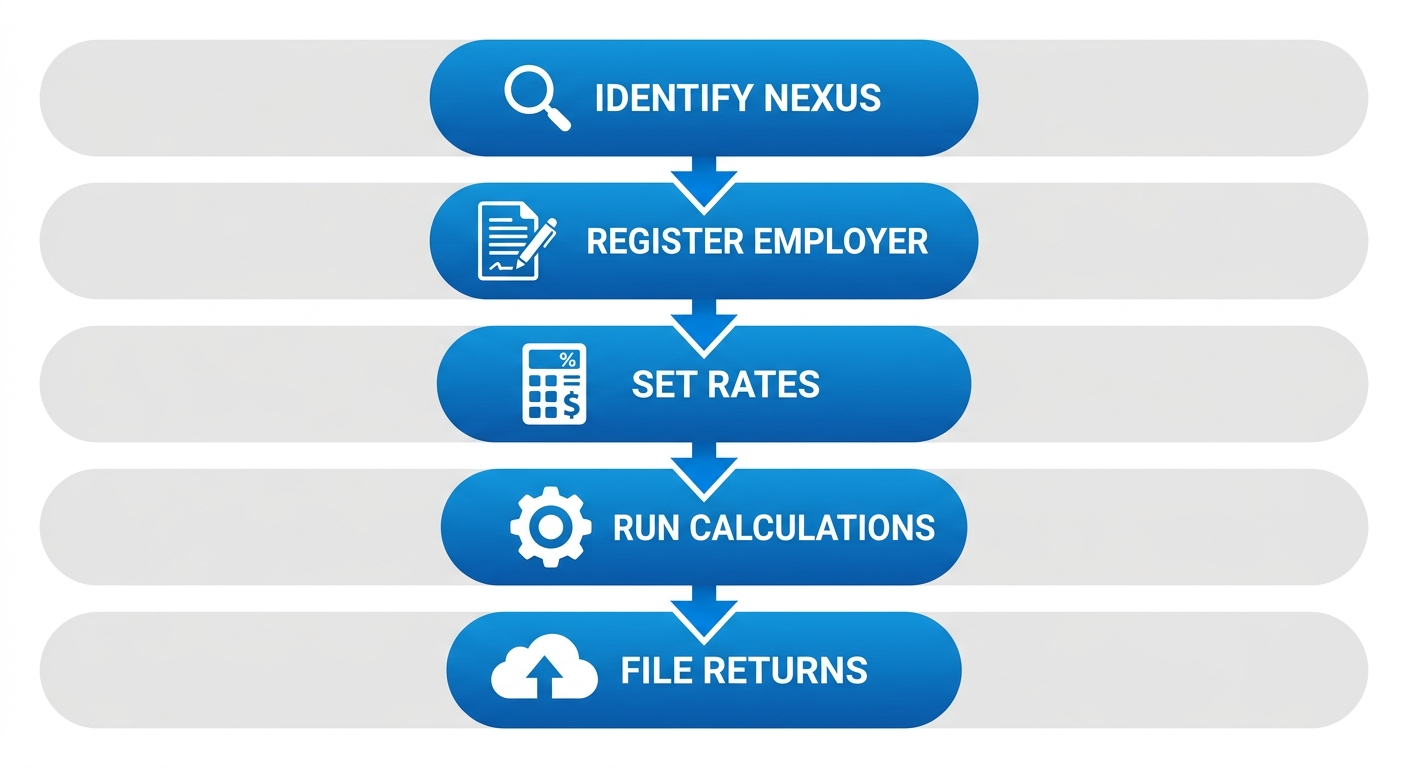
Multi-state payroll processing steps in vertical flow diagram
We become an extension of your team for seamless compliance across states.
Manage Quarterly and Annual Filings
Once multi-state payroll is operational, Multi state Payroll Compliance demands precise management of quarterly and annual filings to avoid penalties. We track federal requirements like Form 941 for payroll taxes, due 04/30, 07/31, 10/31, and 01/31, and annual Form 940 for unemployment taxes by 01/31. State rules vary, with California and New York requiring quarterly withholding returns and unemployment reports, influenced by multi-state tax nexus thresholds.
Annual reconciliations include W-2/W-3 submissions and state wage reports. Follow this checklist for multi-state payroll processing:
- Gather payroll data quarterly and verify accuracy across states.
- File electronically where mandated, meeting all deadlines.
- Retain records for 4 years.
Common pitfalls include missing nexus registrations, leading to late fees. Outsourcing handles complex compliance effectively. Proper filing supports seamless compliance monitoring. Review filings annually to confirm accuracy and address discrepancies.
Leverage PEO Services for Compliance
Overcome these complexities by leveraging PEO services for Multi state Payroll Compliance. Professional Employer Organizations co-employ your workers and assume responsibility for payroll compliance across states. This partnership directly tackles multi-state challenges, reducing your administrative burden.
We expertly manage multi-state tax nexus by monitoring employee locations in Baltimore and beyond, handling registrations, and filing taxes to prevent penalties. Our multi-state payroll processing automates withholding, generates quarterly reports, and prepares year-end W-2s for every jurisdiction. We also coordinate state-specific reporting deadlines and ensure timely deposits, minimizing exposure to fines, administrative delays, and costs.
Key benefits include:
- Access to dedicated compliance experts
- Real-time tracking software
- Audit defense support
- Scalability for growing teams
Partner with My HR Professionals for seamless operations. We become an extension of your team. Implementing PEO partnership starts with a consultation.
Overcoming Common Multi-State Payroll Challenges
Building on these hurdles in Multi state Payroll Compliance, here are targeted solutions to help you navigate varying state withholding rules, multi-state tax nexus thresholds, and multi-state payroll processing efficiently. We at My HR Professionals guide businesses like yours to minimize risks and ensure accuracy across states.
Varying State Withholding Rules
Adopt automated payroll platforms that update tax tables quarterly and flag discrepancies in real-time. These tools calculate withholdings based on each employee’s state of residence and work location, reducing errors. You can cut compliance time by 40% while staying current with changes. This approach keeps your payroll precise and audit-ready.
Establishing Multi-State Tax Nexus
Conduct annual nexus audits by tracking employee work locations and sales volumes against state-specific thresholds, such as 200 transactions or $100,000 in sales. Monitor remote workers closely to avoid unexpected tax obligations. For example, a company expanding to five states reduced penalties by 50% after a thorough nexus review. We help you handle multi-state tax nexus seamlessly.
Streamlining Multi-State Payroll Processing
Segment payroll runs by state groups and reconcile via integrated accounting software. This cuts error rates by 30% and speeds up processing. Assign dedicated processors to oversee runs, ensuring timely filings. Mastering multi-state payroll processing becomes straightforward with these steps, saving you time and resources.
To succeed, follow this checklist: subscribe to state tax alerts, partner with compliant PEOs like us, and train staff biannually on changes. We become an extension of your team for reliable support. For implementation support, explore specialized payroll software next.
Achieving Ongoing Multi-State Payroll Compliance
Building on multi-state challenges, achieving Multi state Payroll Compliance demands proactive strategies. We recommend a structured approach to sustain compliance with taxes, withholding, and reporting across U.S. states.
Follow this 4-step process:
- Monitor state tax changes via official revenue department alerts.
- Deploy automated software for multi-state payroll processing based on employee locations.
- Conduct quarterly audits against nexus rules and remittances.
- Log actions centrally for reviews.
Understand multi-state tax nexus triggers, like employee presence in New York or over $500,000 sales in California. Sync calendars for deadlines–monthly in Texas, quarterly in Florida. Train staff annually on W-4 variations and remote tracking to avoid $1,000 penalties.
For 5+ states, outsource to PEOs, reducing errors 40-60%. Technology and partners enable this–see below. Evaluate providers for scalability, accurate reporting, and year round compliance support and responsiveness.
This article was researched and written with the assistance of AI tools.